
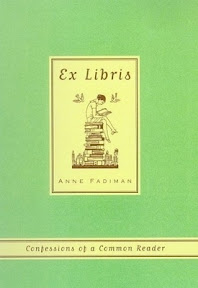
Anne Fadiman's book of essays, Ex Libris: Confessions of a Common Reader, was a delightful and, at times, heartwarming book to read. Over the course of many years, the author jotted down her thoughts about reading and books, which have always been a significant part of her life. Like the pencil marks on the wall denoting the growth of a child, so too do the books booklovers read throughout their lives tell their own story.
Anne's essays are full of humor and sentimentality. While I could not relate to every topic she raised in her book, I did enjoy reading about her experiences as a common reader.
I keep a trusty notebook handy when I read, and the following are my notes as I read each essay. Because of the length of my thoughts, my comments will be split into multiple parts. I hope that you will share some of your own experiences and thoughts as well!
Thoughts of this common reader -
"Marrying Libraries" - Anne and her husband waited five years into their marriage before finally taking the plunge to merge their individual libraries. It proved to be a difficult task because they each had their own organizational preferences, which did not always coincide.
I asked my husband if he remembered the moment in our lives when we decided to marry our libraries (and our CD collections--which I think was somehow harder, although I'm not sure why). My own recollection is a bit fuzzy because, frankly, we did not really have any disagreements about which books should go where. Neither of us was nearly as particular as Anne and George had been. The hard part for me was taking that step at all. There was a finality in the process that was both exciting and a tad bit frightening.
Anjin's own recollection is similar: I don't remember any conflict. It felt like a natural extension of our moving in together. Although I still think of certain books as mine, it's just a vestige of old favorites being added to our communal shelves. The only weirdness was dealing with multiple copies of the same book, but we figured out how to deal with that pretty quick. We see eye-to-eye more often than not, so conflict over books seems a little silly to me.
Anjin brings up an interesting point regarding books that we still consider our own. I confess to feeling that way too about some of the books on our shelves--and about all of the books in the TBR room, even though technically, they are just as much his books as they are mine.
"The Joy of Sesquipedalians" - A sesquipedalian, by definition, is a long word. In this particular essay, Anne reminisces about her love affair with words. Her parents encouraged both her brother and her in their reading and love of words. She and her brother used to search them out, making it a sort of competition. Throughout all her essays, the author's love of words comes through in her writing.
My own love for words is not quite as passionate as Anne's. I do find beauty in words, the way words come together and are manipulated to form images and stories. There is a definite power in words and in how we use them. Sometimes I will come across a word that will thrill me, but it is less common then it was when I was younger.
I asked Anjin his thoughts on the subject and this is what he has to say: I never have had much love for individual words. I'm not the kind that likes the sound of a word or discovering how it's derived. As a writer, I'm more interested in the utility of certain words and how they flesh out the structure of my writing. I like words that evoke more precise meanings or that make a complex statement more concise. The right word in the right place works wonders. But it's the flow of the structure that I care about, not the individual pieces.
In reading this essay one of the questions that popped in my head was whether or not you look up words you do not know when you read? And if you do, do you make a list to go back to later or rush to the dictionary or computer to look them up right away? I admit that a lot depends on where I am and how easily I can access a reference tool to look up definitions. Sometimes I can figure out the meaning of a word based on the context it is used, but other times I prefer to know the exact meaning.
"Scorn Not the Sonnet" - The author writes about her own attempts at writing poetry and the point in which she realized that good, meaningful poetry, as well as the sonnet, involves more than just the mechanics of it. The voice in which the poet speaks can reach deep into the soul if done right. Anne shared how difficult it was when her father, an avid reader himself, lost his sight. He felt his life was over if he could not read. Milton's sonnet, "On His Blindness" helped him through that difficult time. He was able to find other ways to take in the written word, fortunately, and so all was not lost.
My 10th grade English teacher had a poet take over for a couple of weeks to teach our class how to write poetry. I remember how difficult it was for me to write even one poem. I had been writing stories for many years before that, but the poem eluded me. Like Anne, I was stuck on the mechanics of it and that hampered the free flow of thoughts and feelings that I needed to get down on paper. I did discover that year that the most positive comments made in regards to my attempts at poetry came when I wrote the poems in my geometry class. The instructor told me at the end of his stay with us was that I should keep writing poetry. And I did. For a short while, anyway.
My 10th grade English teacher had a poet take over for a couple of weeks to teach our class how to write poetry. I remember how difficult it was for me to write even one poem. I had been writing stories for many years before that, but the poem eluded me. Like Anne, I was stuck on the mechanics of it and that hampered the free flow of thoughts and feelings that I needed to get down on paper. I did discover that year that the most positive comments made in regards to my attempts at poetry came when I wrote the poems in my geometry class. The instructor told me at the end of his stay with us was that I should keep writing poetry. And I did. For a short while, anyway.
Perhaps you have noticed that my challenge participation has been next to nonexistent so far this year. I am considering dropping out of them altogether. That does not mean giving up on reading any of the books on my lists, of course. The very reason they are there is because I want to read them. I have not quite decided yet what I want to do and will put off making any drastic decisions just yet.
My most recent book acquisition is a copy of Dave Eggers What Is the What, a book that has come highly recommended from a variety of people. When I first mentioned the title to my husband, I thought we were going to go into the Abbott and Costello routine, Who's on First?
I hope that you all have a terrific week. Happy reading.
My most recent book acquisition is a copy of Dave Eggers What Is the What, a book that has come highly recommended from a variety of people. When I first mentioned the title to my husband, I thought we were going to go into the Abbott and Costello routine, Who's on First?

I hope that you all have a terrific week. Happy reading.


I love this book. It's one of those which I have to take off the shelf at regular intervals and re-read just to enjoy the company of someone else whose life revolves around the written word. I know how important it is to me because I can even remember when and where I bought it and when you own as many books as I do that in itself is a feat.
ReplyDeleteI've not heard of this book but maybe I'll seek it out.
ReplyDeleteI like the idea of keeping a notepad nearby while reading - by the time I've finished a book and come to review it I forget the best bits!
I enjoyed this book very much.
ReplyDeleteI don't feel like I have been very successful in my challenge commitments either. The deluge of ARCs hasn't helped at all. I am also reading at a much slower pace than last year - and that's probably American Idol's doing. LOL.
ReplyDeleteI hope you're doing well today.
All the best,
Jill
You read the most interesting of books. I do like reading such books.
ReplyDeleteI agree with you over challenge participation. I am not reading for those either. I joined to many and those burnt me out so early!
Today I am here via sunday salon!
I always enjoy your Sunday Salon Wendy. I had not heard of this book but I'm going to look for it now. Sounds like something I'd like to read.
ReplyDeleteGreat post, Wendy. I haven't read this book yet, but I will. Yours is one of many reviews who give it great marks.
ReplyDeleteWhen my husband and I got married he didn't have much fiction - it was mostly technical books and aviation history books...so it was an easy meld and it is always clear which ones are "mine" *smiles*
I agree with Anjin - being a writer, I'm more interested in how words are put together than the individual word...although I *do* love my thesaurus!
I know what you mean about the challenges. I'm signed up for too many - and I've pretty much decided that if I complete them, I complete them; if not, so what? I've been more into reading AREs lately, most of which don't fit with my challenges. I'm just picking what I feel like reading and will see where it all falls out in the end!
Have a good day, Wendy - I hope you're getting the sunshine we're getting up here in the North State!
I'm not very good at expressing myself and I usually talk to myself about a book and then run around trying to find my notebook before I forget lol.
ReplyDeleteMy husband never was much of a reader and the few he did have I already had copies of (in better condition to!) so we put them into my mom's yard sale. Now CD's are another story. I have a few but his collection far outnumbers mine so my paltry few got absorbed into his.
I sometimes look up the meaning of a word if I can't glean from the rest of the text what it means and I either do it right then or I completely forget about it.
I've written a few poems over the years but nothing I'm particulary proud of.
Have a great week!
I'm actually doing better with my challenges this year. Flexibility is the key for me though. I think I learned a bit from last year's, I don't want to say failure, but inability to complete some of the challenges.
ReplyDeleteAs for marrying libraries, in our case this has never been an issue because when we met he was going through a non-reading phase. Too busy with work. And even now that he's reading again he mostly reads non-fiction in Japanese so there's little chance of duplicates.
And about looking up words, lately I just put a sticky note on the word and then look it up when I'm done. This is what I did for A Tale of Two Cities and The Road. I suppose if it seemed critical to the story I might look something up in the middle of reading though.
It does sound like a great book. I'll have to get it someday.
I can relate to the reading challenge issue!
ReplyDeleteI just bought What is the What a few weeks ago as well. And, we also almost had the "Who's on first" type conversation about it, too. :)
I loved Anne Fadiman's essays and I do remember the one in which she and her husband merge their libraries. I recall the moment when they find Homer has sneaked into the 'friends and family' shelf. But I also thought, my goodness, who has a 'friends and family' shelf of books! I haven't taken on any challenges this year as I never do very well with them. Something else always catches my eye as I dutifully head towards the books on the list.
ReplyDeleteI just love the way you structured this post :) Ex-Libris sounds like the kind of book that would make any book lover smile. I must pick it up sometime.
ReplyDeleteAs for challenges, if they are keeping you from reading what you actually want to read, then I'd say it's wise to drop out - for a while, anyway.
I actually BookCrossed my copy of Ex Libris a few years ago; I should pick up another. While at times I did find Fadiman a bit wordy and pretentious, I do identify with her enthusiasm about reading.
ReplyDeleteYour comment about merging CD collections with your husband - and how it seemed harder than merging libraries - made me nod in agreement, Wendy. When my husband and I started combining things, I felt that blending our iTunes libraries was a bigger challenge than our books. That's probably because I tend to judge people more - and therefore feel more judged myself - on musical taste than literary. :-)
I haven't gotten involved with reading challenges, and I suspect that you read enough on your own - books that you choose, and books for review - that you don't really need them.
That sounds like a wonderful book,Wendy. As for marrying libraries, I don't have such issue because my husband and my reading tastes are different, haha... he's more into computer manuals and references so it's very clear which book belongs to whom in our bookshelves. ;P
ReplyDeleteAs for reading challenges, it doesn't really matter as long as you take your pace and enjoy what you're reading. Hope you've a great weekend. :)
I not only want Anne Fadiman's book, I want her life!
ReplyDeleteMarrying libraries...Mr. Bybee keeps to his side of the bookshelf and I keep to mine, although a few rogue books have crept onto my shelf.
I've been a much happier reader since dropping out of challenges altogther. It's peculiar really, since I joined the challenges that looked the most fun, chose the books myself and then.....proceeded to act as if it was a dreaded school assigment.
ReplyDeleteAnne Fadiman's collection of authors essays of their rereading old favorites was really interesting. I'll have to pick up this book since it sounds as if it's more of her own essays this time out.
I loved Ex Libris too, and was fascinated by the Marrying Libraries essay. My husband deferred to me for the organization (after all I am a librarian), and we did keep the few duplicates we had. He has since moved to reading more newspapers and magazines, so I tend to be the buyer of most books and thus think of them as "mine". I also think of the ones I brought in at the beginning as mine. The point we most differ on now is that he is a "keeper" and I tend to pass on those books I don't think I'll read again. He finds this annoying. He was even upset when I tossed my GMAT workbook after I did the test!
ReplyDeleteThis is such a great little book isn't it? And, she has a new one out doesn't?
ReplyDeleteMy husband and I have pretty different tastes in books so we really didn't have a problem marrying our libraries. Thank goodness :)
I should really read this. The part about marrying libraries was interesting to me...have been married since 2000 and have not done this. Or the CDs. In fact, all the books that are 'displayed' in our home are....mine. I'm so greedy about the shelves. I'm not sure why this is...I do know that I have an emotional connection with my books and enjoy being surrounded by them and am sure he would not claim the same desire.
ReplyDeleteI've been remiss in responding to your wonderful comments, and for that I apologize. The week hasn't gotten off the best of starts, I'm afraid.
ReplyDeleteAnn - I only recently became aware of this little gem of a book. I can see why you would return to it again and again. It definitely speaks to the booklover in me as well.
Mrs. S - Keeping notes has definitely helped me considerably, especially in remembering little details I might want to consider putting in a review that I might have forgotten otherwise.
Jeane - It's a good one, isn't it?
Jill - That's my biggest problem, the ARC's. I think I'm reading slower as well this year and probably for the same reason! Haha
Thank you for the well wishes.
Gautami - It's fun to read books about reading, isn't it?
I did so well with the challenges last year, but my focus changed this year in my reading and the challenges have fallen by the wayside. No matter though. I'm still reading and that's what is the most important.
Susan L - Thanks so much! A friend recently read this one and I couldn't believe I'd never heard of it before. Or maybe I had but hadn't been paying close enough attention.
Wendy - Thank you. It was fairly obvious which books were mine and which were Anjin's early on with a few exceptions (some of the classics) because he was mostly into science fiction and fantasy whereas I read everything else. What's especially funny is when I come across a book that we both deny belongs to either of us.
ReplyDeleteI may just follow your lead when it comes to challenges. There's still most of the year ahead of me, right?
Alisia - I've heard wonderful things about What is the What. And how funny that you almost had the same conversation! It's easy to do with a title like that. :-)
Litlove - Ah, yes! That was a funny moment. I never thought of having a "friends and family" shelf, but then, I don't know all that many authors personally. I like the idea though.
It's easy to get tempted by another book, especially when you feel the pull of obligation creeping in. I think it's only natural to want to rebel a little. I did really well last year with the challenges I took on, but this year is another story. It mixes things up a bit anyway.
Nymeth - Thanks! I imagine most booklovers would enjoy this one quite a bit.
I think I've been feeling a little guilty that it's already the middle of March and I haven't started most of the challenges I signed up for. I've been debating whether I want to drop out all together or continue on in the hopes that I may make some progress later on. I am leaning towards Wendy's way of thinking at the moment.
Florinda - Anne Fadiman loves her words, doesn't she? I agree with your thought that she was wordy and even pretentious on occasion. I got that feeling too.
Our musical tastes do say a lot about us, don't they? My husband and I are so different when it comes to music, whereas with books, there's more common ground.
I definitely don't need the challenges to spur on my reading, that's for sure. They were a nice way though of getting to some of those books I'd been wanting to get to that always got passed over though. I'm just going to go with the flow and see where it takes me this year.
Melody - Yes, that would make division of or combining books easy!
And what you said is very true about reading and challenges. It only matters that I'm enjoying what I am reading in the end.
Bybee - I know what you mean! Haha
ReplyDeleteAlthough we do keep our general book collection together, our TBR collections are pretty much separate, although either one of us is free to read anything from the others collection.
Carrie K - I really like the structure of reading challenges myself and it's a shame that I've fallen away from them this year. I think I over committed myself in selecting books to review for various sites and that's what has gotten me into trouble. And it isn't helping reduce my TBR collection at all.
I'd read something about the book you mention, the authors' essays about their rereading old favorites. It's on my wish list to try.
Shonna - I'm definitely the bigger book buyer in the house too, and I'm sure that plays a part in my sense of ownership in some of the books we have in the house.
Although on a lesser scale, I can also relate to you in regards to keeping or passing along books. Both my husband and I are keepers, but in recent years I've had the urge to clean up the shelves and pass along some of the books I won't be rereading again. I never realized how much of a keeper my husband was until that moment, when he staunchly disapproved (and let's not talk about my dad who doesn't even live with us who wasn't pleased with the idea either). My husband is okay now with my letting my books go, but he gets to have veto power.
Iliana - Does she have a new one out? I'll have to look for it. Maybe it's the one Carrie mentioned.
Whether there's a difference in reading tastes seems to make a difference in how easy it is to merge libraries, I'm noticing. Maybe because it's still easy to separate out the two. :-)
Tara - A sister space hog--for books, that is! When I put the bookshelves up in the TBR room, my husband asked that he at least have three shelves for some of his stuff. I have all the rest, which are quite a few.
This looks like a great book! Thanks for posting your thoughts on it. I can tell it has definitely made an impression on you!
ReplyDeleteJaimie - It's one of those books that is easy to relate to as a reader. :-)
ReplyDelete