Before the lawsuits and protests, before the ground-penetrating radar and DNA testing, before we stalked and before the citizens of Jackson County tried to have me arrested, before we ever stuck a shovel in the red dirt of North Florida to exhume bodies, I stood in the women's restroom as the news media gathered in the large room outside and began setting up their cameras and checking their microphones and waiting for me to step before them and tell them what I had learned about the dead boys.I did not want to do this. [opening of We Carry Their Bones]
This is such an effective start to a book. The author is letting me know what to expect, preparing me for an emotional, at times tense, read, and also adding a hint of a more personal nuance to the story about her own experiences and thoughts in how it relates to the events she is about to share with the reader.

A few hours after noon on the first day, with thunderstorms rolling in, we found the first signs of a burial at the bottom of our first shallow hole about thirty meters north of those rows of crooked pipe crosses. [excerpt from 56% of We Carry Their Bones]
I am only about 20% into We Carry Their Bones, and have not yet reached the chapter with the above excerpt. What these boys and their families went through . . . There are no words.
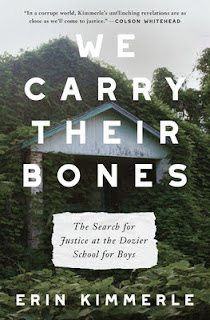
Forensic anthropologist Erin Kimmerle investigates of the notorious Dozier Boys School--the true story behind the Pulitzer Prize-winning novel The Nickel Boys--and the contentious process to exhume the graves of the boys buried there in order to reunite them with their families.
The Arthur G. Dozier Boys School was a well-guarded secret in Florida for over a century, until reports of cruelty, abuse, and "mysterious" deaths shut the institution down in 2011. Established in 1900, the juvenile reform school accepted children as young as six years of age for crimes as harmless as truancy or trespassing. The boys sent there, many of whom were Black, were subject to brutal abuse, routinely hired out to local farmers by the school's management as indentured labor, and died either at the school or attempting to escape its brutal conditions.
In the wake of the school's shutdown, Erin Kimmerle, a leading forensic anthropologist, stepped in to locate the school's graveyard to determine the number of graves and who was buried there, thus beginning the process of reuniting the boys with their families through forensic and DNA testing. The school's poorly kept accounting suggested some thirty-one boys were buried in unmarked graves in a remote field on the school's property. The real number was at least twice that. Kimmerle's work did not go unnoticed; residents and local law enforcement threatened and harassed her team in their eagerness to control the truth she was uncovering--one she continues to investigate to this day.
We Carry Their Bones is a detailed account of Jim Crow America and an indictment of the reform school system as we know it. It's also a fascinating dive into the science of forensic anthropology and an important retelling of the extraordinary efforts taken to bring these lost children home to their families--an endeavor that created a political firestorm and a dramatic reckoning with racism and shame in the legacy of America. [Goodreads Summary]
Does this sound like something you would want to read? What book is your bookmark in right now?


Libraries: do you prefer to visit in person or check out on-line?


Every Friday Coffee Addicted Writer from Coffee Addicted Writer poses a question which participants respond on their own blogs within the week (Friday through Thursday). They then share their links at the main site and visit other participants blogs.
How long does it usually take you to finish a book? (submitted by Billy @ Coffee Addicted Writer)
It depends on a multitude of factors: writing style, length, genre, how engaged I am with the book, access to the book, how many other books I am reading at the time, life and work commitments and responsibilities, my mood and emotional state, non-bookish distractions, my attention span at any given moment, and other reasons I am sure I am forgetting. And honestly, I am all over the map when it comes to the amount of time it takes me to finish a book. It could be one day to over a hundred days. Poetry, manga and graphic novels are often the ones that I can fit in within a day or so. Short story anthologies and audiobooks take the longest for me to get through. The first I stretch out over months, reading a story here and there in between other books; and the latter because fitting in listening time is a challenge for me. I am not as fast as many book bloggers seem to be at finishing books, but I am definitely a faster reader compared to the average person. That is, if you consider the average person reads about twelve to fifteen books a year (at least according to one source).
I hope you all have a wonderful weekend! Be sure and tell me what you are reading and are up to!

© 2023 Musings of a Bookish Kitty. All Rights Reserved. If you're reading this on a site other than Musings of a Bookish Kitty or Wendy's feed, be aware that this post has been stolen and is used without permission.




.png)


.png)