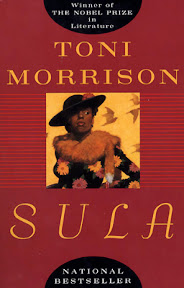
 Sula by Toni Morrison
Plume, 1973
Fiction; 174 pgs
Completed: 06/26/2007
Rating: 
(Very Good)
First Sentence: In that place, where they tore the nightshade and blackberry patches from their roots to make room for the Medallion City Golf Course, there was once a neighborhood.
Reason for Reading: It has been years since I read my first Toni Morrison book,
The Bluest Eye.
Sula was a gift from my parents, and although I had every intention of getting to it, it sat on my TBR shelf for 2 ½ years. It became one of my choices for the
TBR Challenge because I felt it was time I got to it. This is my 6th selection for the
TBR Challenge and my 7th for the
Reading Through the Decades Challenge.
Comments: The novel
Sula paints a vivid picture of a black neighborhood known as Bottom even though it is set high in the hills of Medallion, Ohio. Toni Morrison's writing is beautiful. She captures a moment, a person, and a mood so eloquently, sometimes with imagery and at other times quite bluntly.
Sula is rich in complexity, satire and all the while tragic.
Sula is one of those novels that inspires analysis and discussion, and it is no wonder it is a favorite as required reading for literature courses in the United States. The novel weaves several different themes throughout the story, including that of racism, motherhood, friendship, and values.
Racism was rampant during the time period the book is set, beginning in 1919 and ending in 1965. As Nel travels by train with her mother, Helene Wright, from Ohio to New Orleans to visit Helene's dying grandmother, I was struck by the contrast between the train stations the further south the two traveled. Although segregated, the train stations at the beginning of their journey had restroom facilities for everyone. By the time Nel and Helene drew closer to their destination, the facilities for blacks were non-existent. Instead, they were expected to go out in a field. Other hints of racism were sprinkled throughout the novel, impossible to ignore.
The contrast between the lifestyles of the two friends, Nel and Sula, is extreme. Nel comes from a strict and proper upbringing, raised by a mother who was traditional. Sula had a much different childhood, living with her matriarchal grandmother who was strong and eccentric. Sula's own mother was loose with her child just as she was with the men. Nel and Sula's attraction to each other seemed natural, despite their differences. They had similar natures, both seeking escape from their own realities and finding in each other the part of themselves that they desired most to be like.
Even with the years of separation after Sula disappeared from Medallion, upon her return the two women picked up their friendship where they had left off. They settled into each other’s lives and hearts as if nothing had changed. And yet it had. Nel was married with children. She had adopted a similar life to that of her mother, a more traditional lifestyle. Sula wanted no part of that kind of life, enjoying her independence, and not wanting to have to rely on anyone or have anyone rely on her, a lesson she learned early in life. This would ultimately cause a rift between the two friends and tear their friendship apart.
I am in awe at how gifted a writer Toni Morrison is. She captured the essence of the era, the town, the neighborhood and her characters in all their complexity. Sula is the most complex of all of the characters. She fights against tradition, setting her own path. Unlike her grandmother who was a respected woman in the community and her mother who, while a free spirit herself, had a complacency about her that endeared people to her, Sula instead earned their wrath. Her confidence and arrogance seemed to spurn others in the community. Yet there is a naivety in Sula, buried deep down and difficult to see.
Sula is not a novel that should be rushed through (which is unfortunately what I did); there is a deeper meaning behind so many of the events that take place within the novel. The imagery and symbolism make this book a literature course gold mine. I read this novel for the sheer pleasure of it, not as a scholarly endeavor, and as you can see, my thoughts about the book reflect that. Overall, I enjoyed the novel and perhaps will one day reread it and appreciate it even more.
Favorite Part: The writing itself is one of the best parts of this novel. I cannot stress that enough.
Aside from that, one of my favorite characters was Shadrack, who readers are introduced to almost immediately. He is a war veteran who had been greatly affected by the war, watching those around him die. He is an eccentric character, not one that ignites warm and fuzzy feelings, but is an enigma. He walks through town with a cowbell every January 3rd, the day he has designated as National Suicide Day. While the townsfolk shake their heads in disgust and wonder, the day takes on a special significance even to them, although perhaps not with the same intent that Shadrack had in mind.
The story of how the 3 Deweys came about is another favorite part for me. The three boys were orphans that Eva Peace, Sula’s grandmother, took in, each unrelated and looking nothing alike and yet no one could tell them apart. They were an interesting set of characters, although relatively minor.
Note about the Author: Although not a personal website for the author, Anniina has set up a
website that includes a bibliography of all of Toni Morrison’s work as well as links to interviews with the author and biographies. Take a look!

 With so many contemporary books lining my shelves and even more out there that I have yet to get my hands on, there are also older books that have caught my eye, some classics and others not. Stepping back through time and reading at least one book for every decade over the last century was a worthwhile challenge. My walk through the decades proved to be revealing, both historically and socially, not to mention entertaining. Not all of the books I read for this challenge were set in the time period the novel was written, nor even in this world, and yet each still carries the footprints of the era it was written.


