
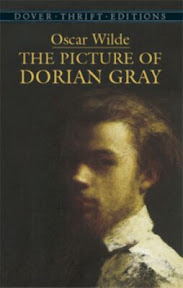
 The Picture of Dorian Gray by Oscar Wilde
Dover, 1993 (Originally Published in 1891)
Fiction; 165 pgs
Completed: 09/21/2007
Rating:
 (Fair)
First Sentence: The studio was filled with the rich odour of roses, and when the light summer wind stirred amidst the trees of the garden there came through the open door the heavy scent of the lilac, or the more delicate perfume of the pink-flowering thorn.
Reason for Reading: This is my final selection for Kathrin’s Classics Reading Challenge and my second for the Book to Movie Challenge. I first decided I wanted to read this book after seeing the movie The League of Extraordinary Gentleman. Although the movie itself didn’t impress me, several of the characters did, especially Dorian Gray.
From the Publisher: Enthralled by his own exquisite portrait, Dorian Gray makes a Faustian bargain to sell his soul in exchange for eternal youth and beauty. Under the influence of Lord Henry Wotton, he is drawn into a corrupt double life, where he is able to indulge his desires while remaining a gentleman in the eyes of polite society. Only Dorian's picture bears the traces of his decadence. A knowing account of a secret life and an analysis of the darker side of Victorian society, The Picture of Dorian Gray offers a disturbing portrait of an individual coming face to face with the reality of his soul.
Comments: I am not sure what to say about this book. It is difficult to take on a classic, a book revered and analyzed by many. I read this novel more out of curiosity than to gain a deeper meaning. Dorian Gray is a famous character that is mentioned and alluded to in all forms of media. I wanted to experience the “real” Dorian Gray and read his story.
Oscar Wilde is well known for his play writing, but he also wrote poetry and short stories. I had seen one of his plays in college, The Importance of Being Earnest, and remember enjoying it. The Picture of Dorian Gray is Wilde’s only novel, and it caused quite a stir in its day. It was deemed as being immoral, in part for its theme of aestheticism, which places value on youth and beauty, as well as hedonism and a rather superficial view of society. The other concern that many people in Wilde’s day had was the homoerotic undertones throughout the novel; this theme would play a part in the author’s own life, resulting in his arrest and conviction in 1895 on charges of gross indecency under British sodomy laws.
I was not overly impressed with Mr. Wilde's novel. The author’s penchant for poetry was obvious in his descriptions and drawn out thought sequences, which occasionally left my mind to wander. The playwright in him ensured there was heavy dialogue during the first third of the novel where the characters seem to engage in endless discussions. The conversations were at times amusing and had definite political and social overtones to them fitting to the time period. There was quite a bit of melodrama in both the characters’ speeches and actions throughout the book. I wish now I had counted how many times someone flung himself onto a couch, chair or whatever during a moment of anguish.
I did not care for most of the characters. I did have some sympathy for James Vane, the brother of Sibyl Vane who was a young and beautiful actress that fell madly in love with Dorian. Lord Henry Wotton annoyed me quite a bit in the beginning of the novel; however, he was one of the more interesting characters. He was quite comical, really. I cannot say if that was intentional or not. Basil Hallward seemed out of place most of the time, overly anxious, and only occasionally the voice of reason. His part was well played against Lord Henry during their discussions—the two balanced each other out both in opinion and manner.
Dorian Gray himself was somewhat in the shadows for the first half of the novel, only solidifying later on. A lot of his actions go unwritten but are alluded to throughout the book. I found myself feeling sorry for him early on, during his more impressionable moments, while at the same time wanting to shake him and tell him to stop being so egotistical. The author did a good job of conveying the pain and frustration that Dorian felt over his situation.
The last fifty-eight pages of the book were by far my favorite part. Oscar Wilde spent quite a while setting the stage for those final chapters, and once the book reached the twelfth chapter, the story took off, the plot moved forward quickly, and I did not want to put the book down.
I can see why The Picture of Dorian Gray is considered a classic. It captures several of the social and political movements of its time and stirs up controversy even today. The character of Dorian Gray is one that has become an icon of sorts through the years.
I am glad I took the time to read The Picture of Dorian Gray. I did not dislike it so much as to want to toss it in the unread pile. I liked it enough to finish it.
Visit The Official Oscar Wilde website for information about the author and his works.


Wow. I'm sorry you didn't like this. I'm in the category of just loving Oscar Wilde. I've read his plays, but I thought Dorain Gray was wonderful. So witty and eloquent.
ReplyDeleteEveryone has their own tastes though!!
I figure I probably will be in the minority in regards to this book, Stephanie. I do think that his writing was witty and eloquent, as you described it, but I felt it was overdone, which was a big turn off for me.
ReplyDeleteI read it 2 or 3 years ago and I wasn't too thrilled with it either. I'm glad to have read it because Dorian Gray is referred to so often but meh! Have you seen the film, 'Wilde'? I found it much more intriguing than his book. ;P
ReplyDeleteVictorian writing is often full of flowery phrases and overblown descriptions which be quite tiresome to read. Characters are simplified good/evil with no in between. But underneath all that silliness is a very original morality play that would be quite the thriller if written today. Too bad. Thanks so much for visiting my blog. I admire your reviews very much. Hope you have a wonderful day!
ReplyDeleteTanabata - No, I haven't seen the film, "Wilde". I'll have to see if Netflix has it. :-)
ReplyDeleteJaimie - Thank you so much! I've read some Victorian writing in the past and really enjoyed it (Jane Eyre is one of my favorite novels). I really wanted to like Oscar Wilde's novel, but I think the writing distracted me from the actual story in this instance. I agree, it would definitely make a great thriller if written today.
I'm with you on this one. I'm glad I read it, but the idea was better than the actual reading of it. Too much philosophizing, too much wittiness. In theory, it should be great.
ReplyDeleteI liked the characters more than the movie too. I always meant to read this book when I was going through the classics but never got around to it.
ReplyDeleteraidergirl - Yes, I think so too. The story itself was very promising, but it was trapped by everything else.
ReplyDeleteLadytink - I really liked the concept of The League of Extraordinary Gentlemen. :-)
I recently saw a bit of the movie on AMC (I think). The actor who played Dorian gave me the creeps so I didn't watch much. He looked... fake? Like his face was made of wax or something. It was truly strange.
ReplyDeleteEither that or I'd had one too many...
cjh
CJ - LOL I bet it was done on purpose to remind viewers that he was not aging. Some of the make-up and special effects back then are quite hilarious by today's standards, weren't they?
ReplyDeleteOscar Wilde's strength was in his plays, so it's not a surprise that this book might not have had the same magic.
ReplyDeleteIt's funny, though: Tony Bourdain the chef did an episode of No Reservations on the Travel Channel in Paris, and he stayed in the same room that Oscar Wilde died in.
Sorry to hear that you didn't like this one! I have it on my TBR and will probably get around to it someday, but for some reason I've never been in much of a hurry. lol
ReplyDeleteI hope to get around to this some time next year hopefully. I really like his fairy tales in particular The Happy Prince. Sorry you didn't like this so much, but do try his short stories.
ReplyDelete"The Picture of Dorian Gray" is a classic b/w movie also. I saw it many years ago and it terrified me!! That portrait of him---yuch! But, after reading your review I will read the novel. If you haven't seen the old movie, you should take a look -- especially after your review of the book.
ReplyDeleteKaren - I quite enjoyed the play by him I did see. He certainly was very talented and has had a lasting impact on the art of literature.
ReplyDeleteAndi - It is a short one and so maybe that will help motivate you to pick it up one day. :-)
Rhinoa - Thanks for the recommendation. I will definitely check out his short stories.
Violetlady - I have the movie in my netflix queue. :-)
I've never been particularly interested in reading this so I'm glad your review did compel me to change my mind. There's too many other books left to get to.
ReplyDeleteFramed - And it will be impossible to get to all the ones we'd like to read in our lifetime, no doubt. :-)
ReplyDeleteAs I was reading I knew I remembered the character from somewhere, after I was done I noticed that it was from the League of Extraordinary Gentleman. He was a perfect character for that type of movie.
ReplyDeleteI wanted more descriptions of his devious actions although those included were quite nice.
I loved how excited he got when he discovered the body was in fact Vane's and he only had one more thing to fear.
Thank you for stopping by, Rybu! Really, I think that was one of the things that would have made the book better for me--a fuller and more complete picture of Dorian and his actions earlier on. So much was eluded to and yet so little shared until the last third of the book (which I liked quite a bit).
ReplyDeleteI was half hoping Vane would take Dorian out, I admit. :-) And so when Dorian discovered who the dead man was, I was a little disappointed. Still, I can't imagine it happening any other way than it did. It was a great scene in the book.
Wow that's an old book! I've added it to the Book to Movie listing.
ReplyDeleteThanks, Callista.
ReplyDeleteBut dude!! This is my favourite book EVER!!! :( lol
ReplyDeleteLoki - Thanks for visiting! I know quite a few people who loved this one, so I know I'm in the minority. I am glad I read it at least. :-)
ReplyDelete